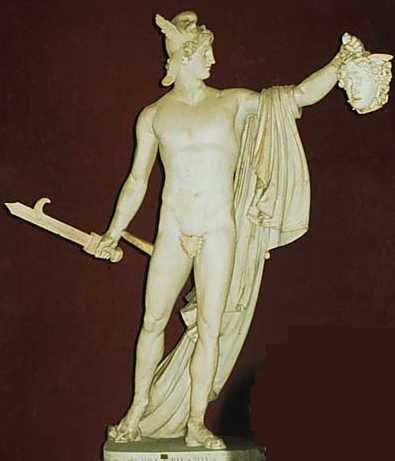
PERSEUS
Acrisius, an ancient king of Argos, had been warned by an oracle that he should perish by the hand of his grandson. On discovering, therefore,that his daughter Danae had given birth to a son, Acrisius endeavored to escape his fate by setting both mother and child adrift on the sea. They were saved, however, by the help of Jupiter; and Perseus, the child, grew up at the court of Polydectes, king of Seriphos, an island in the Aegean Sea. On reaching manhood, Perseus was sent by Polydectes to fetch the head of Medusa, one of the Gorgons. This dangerous task he accomplished with the help of Apollo and Minerva, and on his way home he rescued Andromeda, daughter of Cepheus, from a sea-monster. Perseus then married Andromeda, and lived some time in the country of Cepheus. At length he returned to Seriphos, and turned Polydectes to stone by showing him the Gorgon's head; he then went to the court of Acrisius, who fled in terror at the news of his grandson's return. The oracle was duly fulfilled, for Acrisius was accidentally killed by a quoit thrown by Perseus.
1. THE ARK
Haec narrantur a poetis de Perseo. Perseus filius erat Iovis, maximi deorum; avus eius Acrisius appellabatur. Acrisius volebat Perseum nepotem suum necare; nam propter oraculum puerum timebat. Comprehendit igitur Perseum adhuc infantem, et cum matre in arca lignea inclusit. Tum arcam ipsam in mare coniecit. Danae, Persei mater, magnopere territa est; tempestas enim magna mare turbabat. Perseus autem in sinu matris dormiebat.
Danae. A proper name borrowed by Latin from Greek with forms not given in the regular Latin declensions.
enim. This word commonly stands second in its clause.
turbabat. in the imperfect tense to denote a state of things existing at the past time indicated by territa est.
autem. This word has the same peculiarity of position as enim; so also igitur.
2. JUPITER SAVES HIS SON
Iuppiter tamen haec omnia vidit, et filium suum servare constituit.Tranquillum igitur fecit mare, et arcam ad insulam Seriphum perduxit.Huius insulae Polydectes tum rex erat. Postquam arca ad litus appulsa est, Danae in harena quietem capiebat. Post breve tempus a piscatore quodam reperta est, et ad domum regis Polydectis adducta est. Ille matrem et puerum benigne excepit, et iis sedem tutam in finibus suis dedit. Danae hoc donum libenter accepit, et pro tanto beneficio regi gratias egit.
Seriphum. Latin says 'the island Seriphos,' but English more often says 'the island of Seriphos.'
appulsa est. Postquam is regularly followed by the perfect or present indicative, but the English translation usually requires the pluperfect.
quodam. “Quidam” means 'certain' as applied to some person or thing not fully described, while “certus” means 'certain' in the sense of'determined','sure'.
ad domum. This means 'to the house'; 'to be brought home' would be “domum adduci”, without the preposition.
Ille is often used when the subject is changed to a person mentioned in the preceding sentence. In this use it is to be translated 'he.'
3. PERSEUS IS SENT ON HIS TRAVELS
Perseus igitur multos annos ibi habitabat, et cum matre sua vitam beatam agebat. At Polydectes Danaen magnopere amabat, atque eam in matrimonium ducere volebat. Hoc tamen consilium Perseo minime gratum erat. Polydectes igitur Perseum dimittere constituit. Tum iuvenem ad se vocavit et haec dixit: "Turpe est hanc ignavam vitam agere; iam dudum tu adulescens es. Quo usque hic manebis? Tempus est arma capere et virtutem praestare. Hinc abi, et caput Medusae mihi refer."
multos annos. Duration of time is regularly expressed in the accusative case.
eam. Latin has no pronoun of the third person, and “is” often takes the place of one; it is then to be translated 'he,' 'she,' 'it,' 'they,'according to its form.
haec. The literal translation would be 'these things,' but we must say 'thus' or 'as follows.'
es. With iam dudum and similar expressions of duration, the present indicative is often used to denote an action or state begun in the past but continuing in the present. The English equivalent is the perfect.
hic, is not the pronoun, but an adverb here.
mihi. This dative may be translated 'for me' or 'to me' with a verb of motion.
refer. “Dico, duco, facio, fero” have the imperative forms “dic, duc, fac, fer”, instead of “dice”, etc.
4. PERSEUS GETS HIS OUTFIT
Perseus ubi haec audivit, ex insula discessit, et postquam ad continentem venit, Medusam quaesivit. Diu frustra quaerebat; namque naturam loci ignorabat. Tandem Apollo et Minerva viam demonstraverunt. Primum ad Graeas, sorores Medusae, pervenit. Ab his talaria et galeam magicam accepit. Apollo autem et Minerva falcem et speculum dederunt. Tum postquam talaria pedibus induit, in aera ascendit. Diu per acra volabat; tandem tamen ad eum locum venit ubi Medusa cum ceteris Gorgonibus habitabat. Gorgones autem monstra erant specie horribili; capita enim earum anguibus omnino contecta erant. Manus etiam ex aere factae erant.
Perseus. When the subordinate and the principal clause of a Latin sentence have the same subject, this usually stands first, followed by the subordinate clause.
venit. This can be present or perfect
Graeas. The Graeae were three old women who had one eye and one tooth in common, and took turns in using them.
galeam. This belonged to Pluto, the god of the under world of the dead, and whosoever wore it was invisible. The story is that Perseus compelled the Graeae to tell him how to obtain the helps to his enterprise by seizing their tooth and eye.
pedibus, 'on his feet,' dative of indirect object.
aera. "Aer" is borrowed from Greek, and keeps this Greek form for its accusative.
volabat. Distinguish between "volo, volare", and "volo, velle".
ceteris. "Ceteri" is used to denote all not already named ('the other'), while "alii" denotes some of those who have not been already named ('other').
specie horribili, 'of terrible appearance.' ablative of description. A noun never stands alone in this construction,
contecta. This and factae below are used as predicate adjectives, not to form the pluperfect passive with erant. Translate, therefore, 'were covered.' not 'had been covered.'
5. THE GORGON'S HEAD
Res difficillima erat caput Gorgonis abscidere; eius enim conspectu homines in saxum vertebantur. Propter hanc causam Minerva speculum Perseo dederat. Ille igitur tergum vertit, et in speculum inspiciebat; hoc modo ,ad locum venit ubi Medusa dormiebat. Tum falce sua caput eius uno ictu ,abscidit. Ceterae Gorgones statim e somno excitatae sunt, et ubi rem viderunt, ira commotae sunt. Arma rapuerunt, et Perseum occidere volebant. Ille autem dum fugit, galeam magicam induit; et ubi hoc fecit,statim e conspectu earum evasit.
vertebantur. The imperfect here denotes customary action, one of its regular uses.
hoc modo, ablative of manner.
venit, dormiebat. The perfect simply expresses an action which took place in past time, the imperfect tells of a state of things existing at that past time.
fugit. When dum means 'while,' 'as' it is followed by the presentindicative, even when used of past events.
fecit. Like "postquam", ubi has the present or perfect indicative, where English would use the pluperfect.
6. THE SEA-SERPENT
Post haec Perseus in finis Aethiopum venit. Ibi Cepheus quidam illo tempore regnabat. Hic Neptunum, maris deum, olim offenderat; Neptunus autem monstrum saevissimum miserat. Hoc cottidie e mari veniebat et homines devorabat. Ob hanc causam pavor animos omnium occupaverat.Cepheus igitur oraculum dei Hammonis consuluit, atque a deo iussus est filiam monstro tradere. Eius autem filia, nomine Andromeda, virgo formosissima erat. Cepheus ubi haec audivit, magnum dolorem percepit.Volebat tamen civis suos e tanto periculo extrahere, atque ob eam causam imperata Hammonis facere constituit.
illo tempore, ablative of time.
regnabat. Observe the force of the tense, and try to find the reason for each change of tense in this paragraph.
Hic. This must here be translated simply 'he.'
omnium, 'of all men.' or 'of all.' The adjective is used as a noun, as in the second of the English expressions.
oraculum. It was believed in antiquity that the will of the gods and aknowledge of future events might be learned at certain shrines, of which the most famous were those of Apollo at Delphi, of Zeus or Jupiter at Dodona, and of Hammon in Egypt. Hammon was really an Egyptian god,represented as having the horns of a ram, but he was identified by the Greeks with Zeus and by the Romans with Jupiter.
filiam. Where there is no ambiguity, the possessive is often omitted in Latin.
autem, often, as here, simply introduces an explanation ('now'),
nomine, 'by name.'
civis suos, 'his subjects.'
7. A HUMAN SACRIFICE
Tum rex diem certam dixit et omnia paravit. Ubi ea dies venit, Andromeda ad litus deducta est, et in conspectu omnium ad rupem adligata est. Omnes fatum eius deplorabant, nec lacrimas tenebant. At subito, dum monstrum exspectant, Perseus accurrit; et ubi lacrimas vidit, causam doloris quaerit. Illi rem totam exponunt et puellam demonstrant. Dum haec geruntur, fremitus terribilis auditur; simul monstrum horribili specie procul conspicitur. Eius conspectus timorem maximum omnibus iniecit. Monstrum magna celeritate ad litus contendit, iamque ad locum appropinquabat ubi puella stabat.
certam. "Dies" is regularly masculine, but when used of an appointed day it is often feminine.
omnia, 'all things,' 'everything,' or 'all.'
quaerit. The present is often used of a past action instead of the perfect, to bring the action more vividly before us as if it were taking place now. This is called the historical present.
haec geruntur, 'this is going on.'
horribili. Here the adjective is made emphatic by being put before its noun; the same effect is gained by putting "horribili" last in its clause.
omnibus, dative of indirect object after the compound verb"(in+iacio)". Translate 'inspired in all,' but the literal meaning is 'threw into all.'
8. THE RESCUE
At Perseus ubi haec vidit, gladium suum eduxit, et postquam talaria induit, in aera sublatus est. Tum desuper in monstrum impetum subito fecit, et gladio suo collum eius graviter vulneravit. Monstrum ubi sensit vulnus, fremitum horribilem edidit, et sine mora totum corpus in aquam mersit. Perseus dum circum litus volat, reditum eius exspectabat. Mare autem interea undique sanguine inficitur. Post breve tempus belua rursus caput sustulit; mox tamen a Perseo ictu graviore vulnerata est. Tum iterum se in undas mersit, neque postea visa est.
suo, eius. Distinguish carefully between these words. "Suus" is used of something belonging to the subject, "eius" of something belonging to some other person or thing just mentioned.
sustulit. Notice that the perfect forms of "tollo" are the same as those of "suffero (sub + fero)", 'endure.'
neque, here to be translated 'and ... not.' "Neque" is thus used regularly for "et non".
9. THE REWARD OF VALOR
Perseus postquam ad litus descendit, primum talaria exuit; tum ad rupem venit ubi Andromeda vincta erat. Ea autem omnem spem salutis deposuerat,et ubi Perseus adiit, terrore paene exanimata erat. Ille vincula statim solvit, et puellam patri reddidit. Cepheus ob hanc rem maximo gaudio adfectus est. Meritam gratiam pro tanto beneficio Perseo rettulit; praeterea Andromedam ipsam ei in matrimonium dedit. Ille libenter hoc donum accepit et puellam duxit. Paucos annos cum uxore sua in ea regione habitabat, et in magno honore erat apud omnis Aethiopes. Magnopere tamen matrem suam rursus videre cupiebat. Tandem igitur cum uxore sua e regno Cephei discessit.
exanimata, used here as a predicate adjective.
rettulit. 'To give thanks' or 'thank' is usually "gratias agere"; "gratiam referre" means 'to show one's gratitude,' 'to recompense' or 'requite.'
duxit. This word came to mean 'marry,' because the bridegroom 'led'his bride in a wedding procession to his own home. It will be seen,therefore, that it can be used only of the man.
10. POLYDECTES IS TURNED TO STONE
Postquam Perseus ad insulam navem appulit, se ad locum contulit ubi mater olim habitaverat, sed domum invenit vacuam et omnino desertam. Tris dies per totam insulam matrem quaerebat; tandem quarto die ad templum Dianae pervenit. Huc Danae refugerat, quod Polydectem timebat. Perseus ubi haec cognovit, ira magna commotus est; ad regiam Polydectis sine mora contendit, et ubi eo venit, statim in atrium inrupit. Polydectes magno timore adfectus est et fugere volebat. Dum tamen ille fugit, Perseus caput Medusae monstravit; ille autem simul atque hoc vidit, in saxum versus est.
quod, not the relative pronoun, but a conjunction.
eo, the adverb.
in atrium. Although inrupit means 'burst "into",' the preposition is nevertheless required with the noun to express the place into which he burst.
11. THE ORACLE FULFILLED
Post haec Perseus cum uxore sua ad urbem Acrisi rediit. Ille autem ubi Perseum vidit, magno terrore adfectus est; nam propter oraculum istud nepotem suum adhuc timebat. In Thessaliam igitur ad urbem Larisam statim refugit, frustra tamen; neque enim fatum suum vitavit. Post paucos annos rex Larisae ludos magnos fecit; nuntios in omnis partis dimiserat et diem edixerat. Multi ex omnibus urbibus Graeciae ad ludos convenerunt. Ipse Perseus inter alios certamen discorum iniit. At dum discum conicit, avum suum casu occidit; Acrisius enim inter spectatores eius certaminis forte stabat.
Acrisi. In Nepos, Caesar, Cicero, and Vergil, the genitive singular of second-declension nouns in "-ius" and "-ium" ends in "i", not "ii"; but the nominative plural ends in "ii", and the dative and ablative plural in"iis".
istud. "iste" is commonly used of something connected with the person addressed. Here the meaning may be 'that oracle I told you of.'
neque enim, 'for ... not,' as if simply "non enim", but Latin uses "neque"to connect the clauses.
in omnis partis, 'in all directions' or 'in every direction.'
discorum. The discus was a round, flat piece of stone or metal, and the athletes tried to see who could throw it farthest.
casu. This is one of the ablatives of manner that do not take "cum".