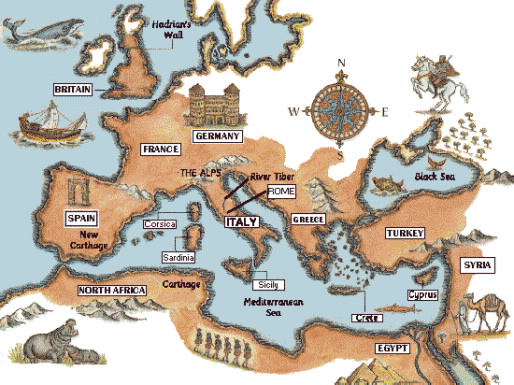
Latin was at first the language
of Latium, the ancient name of the area around the mouth of the River
Tiber on the western coast of Italy. Between the 4th
and the 1st. centuries before the birth of Christ the people
of Rome conquered Latium, then all Italy and finally much of Europe,
North Africa and the Middle East. Roman soldiers, traders and settlers
spread Latin throughout their empire.
Fig.1: The
Roman Empire in the Second Century A.D,
The Roman Empire collapsed
in the 5th century after Christ but Latin continued to be spoken in
many parts of southern Europe. There were already differences in the
way the language was spoken in different areas and these different dialects
(方言)
gradually changed into Spanish, Portuguese, French and Italian. Because
they developed from Latin spoken by the Romans, these modern languages
are known as `Romance languages’ and we also sometimes use the word
`Latin’ as an adjective for the peoples and cultures associated with
them. Thus Central and South America, where Spanish or Portuguese are
spoken, are known as `Latin America.’
The similarities between Latin
and the modern Romance languages can easily be seen by comparing the
present tense of the verb `love’ in each of them (see Table 1, pg.2).
Written French has changed more than written Spanish, Portuguese or
Italian and spoken French (shown in phonetic symbols) has changed even
more. A Spaniard can understand most simple sentences in Italian (and
vice versa) but, unless they have already studied French, neither of
them will understand a French person speaking. However, all Romance
languages are still so close to the original Latin and to each other
that learning a little of any one of them makes it easier when you start
learning another.
English is not a Romance language
but it has borrowed many words directly from Latin (e.g. velocity (<
vēlōcitās), altitude (<altitūdō)) and others indirectly
though French (e.g. measure (<Old Fr. mesure
< Lat. mēnsūra), beef (< Fr. boeuf
< Lat. bovem, cow)). This means that if you know the background
to a Latin passage you may be able to guess what it is about even before
you have started Latin lessons.
Table 1: The Verb `love’
in the Romance Languages
LATIN SPANISH PORTUGUESE
ITALIAN FRENCH ENGLISH
AMŌAMO AMO AMO AIME /eim/ (I) love
AMĀS AMAS AMAS AMI AIMES
/eim/ (You) love (s.)#
AMATAMA AMA AMA AIME
/eim/ (He/she) loves
AMĀMUS AMAMOS AMAMOS AMIAMO AIMONS
/eimõ/* (We) love
AMĀTIS AMÁIS AMAIS AMATE AIMEZ
/eimei/ (You) love (pl.)
AMANT AMAN AMAM AMANO AIMENT /eim/ (They) love
NOTES:
# There is a special from for
the singular in old English - `(thou) lovest’
* The sign ~ over a vowel means
that it is pronounced nasally, with air escaping through the nose as
well as through the mouth.
_____________________
The pronunciation of Latin
We cannot be completely sure
how Latin originally sounded but we know roughly what it was like because
we have descriptions of Roman speech by ancient authors and we can also
compare how the sounds developed in the modern Romance languages. Today
scholars usually read (or speak) Latin using what we think were the
original sounds. However, the Catholic Church (天主教教會) still uses a pronunciation similar
to that of modern Italian and you will often hear this in recordings
of church music or of medieval Latin. In the table below, the church
pronunciation has been given in square brackets after the original sound.
VOWELS
The main vowels each had a
short and a long sound. In Latin as the Romans wrote it, and as it is
usually printed today, the vowel is written the same way whether it
is pronounced short or long. However, in texts written for beginners
long vowels are often marked by a straight line over the top.
Ā
(long) like /A:/ in father A (short) really like /«/ or
/Ã/ in about
or gun but in Britain
the
sound /Q/
in hat is often
used instead.
Ē (long) roughly
like /eI/
in dayE (short) like /e/ in bed
Ī
(long) like /i:/ in see I
(short) like /I/ in sit
(when followed by another consonant,
I normally had the sound /j/ as in yard. In medieval (中世紀的)documents
this sound is often written as J, but there was no J in
the original Latin alphabet))
Ō
(long) like /«U/ in go O
(short) like // in got
Ū
(long) like /u:/ in fool U
(short) like /U/ in full
Y
was used only in Greek loan words. The original Greek sound was the
vowel heard in Cantonese 書but, as this sound was not used in
native Latin words, Romans tended to replace it with the short sound
for I - like /I/ in sit.
For this reason, the letter was called ī Graeca
(`Greek I’), the name it still has in modern Italian (see below for
names of the letters)
DIPHTHONGS
AE like /aI/
in die [Church pronunciation is. like /eI/ in day or /e/ in bed.
This pronunciation is also used by the readers of Latin news on Finnish
Radio (http://www.yleradio1.fi/nuntii ), even though they follow the original,
ancient pronunciation for most other Latin sounds]
OE like /I/
in oil
AU like /aU/
in out
EI like /eI/
in day (but often these two letters were pronounced as separate vowels
- /e-i:/ )
CONSONANTS
These were always pronounced
as written, so a double consonant was pronounced as two separate sounds
or as a longer sound than that represented by a single consonant. So
ille (that) was pronounced il-le
C always like /k/ in
cake or king [in church pronunciation, C has the sound /tS/ (as in
church)
when it
comes before I or E]
G always like /g/
in good or girl [in church pronunciation G has the sound /dZ/ (as in
gentle) when it comes before I or E]
M when reading Latin
today, we nearly always pronounce this like English /m/. However, the
Romans themselves, at least in poetry, often did not pronounce a final
M fully. Instead the vowel before it was nasalised, that is, air
passed out through the speaker’s nose as well as his month. There
are many vowels of this kind in modern French.
T always like /t/ in
tin [in church pronunciation, T often has the sound
/ts/ (as in hats) when it is
followed
by I or E]
V like /w/ in we [in
church pronunciation, V has the sound /v/ as in
very]
(in the Romans’ own alphabet
V was just another shape for U and both letters could represent
either the vowel sound /v/ or the consonant /w/. However, when Latin
is printed today, only U is normally used for the vowel sound
and only V for the consonant. An exception is in the letter combination
QU, where we write U but use the pronunciation /kw/ - this,
of course, is normally the way QU is pronounced in English –
e.g. queen, question etc.).
STRESS:
Latin words were never stressed
on their final syllable, so in a word of two syllables the stress was
always on the first (this is what usually – but not always- happens
with English two-syllable words).
When a word had three or more
syllables, the stress was either on the second-to-last or on the third
syllable from the end:
If the vowel in the second-to-last
syllable was long OR if it was followed by two or
more consonants, the second-last-syllable was stressed.
If the vowel in the second-last syllable
was short and was not followed by two
consonants,
the stress was placed on the third syllable from the end.
In using these rules, you need
to remember that:
An l or r
following another consonant was regarded as combining with that consonant
to form a single sound. Thus combinations like dr, cl
etc.did NOT make a short vowel in front able to take the stress.
The consonant x
was really two sounds /ks/, so a short vowel in front COULD take the
stress
The letter h
was ignored in counting the number of consonants
Some examples of how this system
works are given below. The stressed vowel is shown italicised and
in red:
amō
(I love) Two-syllable word, stress on first syllable
amās
(You (sing.) love) Two-syllable word, stress on first syllable
āmāmus
(We love) Three-syllable word, stress on second syllable from
the end as it
has
a long vowel
contendunt
(They struggle) Three-syllable word, stress on second syllable
from the end as the
vowel,
although short, is followed by two consonants
extraxi
(I dragged out) Three-syllable word, stress on second syllable
from the end as the
short vowel is followed by x, which counts as two consonants
corrigunt
(They correct) Three syllable word, stress on third syllable from
the end as the
second vowel
from the end is short and there is only one consonant after it.
exedra Three syllable word, stress
on third syllable from the end as the
second vowel from the end is short
and is followed by dr, which
counts
as only one consonant
dominus
(lord) Three syllable word, stress on third syllable from the
end as the
second vowel
from the end is short and there is only one consonant after it.
We are not completely certain
about the Romans’ own names for the letters of alphabet. They borrowed
and slightly changed the alphabet used by the Greeks, who themselves
had adapted letters used by speakers of Semitic languages on the eastern
shore of the Mediterranean (you can see how the shapes changed if you
go to http://www.wam.umd.edu/~rfradkin/latin.html ) The Greeks also borrowed, with small
changes, the original Semitic names for these letters (alpha, beta,
gamma etc.) but the Romans seem to have made new, shorter ones based
simply on the sound each letter represented. The Roman names were probably
as follows:
A B
C D E F G H I K L M N O P Q R
ā bē cē dē ē ef gē hā ī kā el em en ō pē qū er
S T V X Y Z
es tē ū eks ī Graeca zēta
The modern English names are
very similar, the main change being the change from /ei/ to /i:/, a
sound change that also explains why English me
is now pronounced as /mi:/.
B. Nouns
1. Cases: Latin nouns
change their endings to show the grammatical role of the noun in a sentence
and these different forms of the noun are known as its CASES. The endings
for each case are different for different types of noun and each type
is known as a DECLENSION. The table below shows the main endings for
the three most important declensions. The words given as examples are
silva (forest), deus (god) and rex
(king). I have given each case a name which describes its function but
I have also given in brackets the traditional names which you will find
in most grammar books.
Notice that sometimes the same
ending is used in different cases of the same word (for example silvae
can be a plural subject, a singular possessive case or a singular indirect
object). The other words in a sentence will normally make it clear what
the meaning is. Notice also that in the first and second declensions
the stem of the word (the past before the ending) stays the same but
that in the third declension the singular subject form may have a different
stem from the other forms of the noun. A Latin dictionary always
gives you two forms of a noun: the singular subject and the singular
possessive case. In this way, you can tell what declension it belongs
to and also (for the third declension) what the two forms of the stem
are.
A few second declension nouns
with a stem ending in –er (e.g. puer (boy),
magister (teacher) ) do not have –us
for the singular subject form but add the normal endings for other forms.
Some words keep –er before these endings (e.g. puerum, puerī)
but others drop the -e-
(e.g. magistrum, magistrī)
When you use someone’s name
to speak to them, you normally use the same form as the subject of a
sentence. However, second declension nouns usually change the singular
–us ending to –e.
2. Gender: Nouns in
Latin are either masculine, feminine or neuter. With words referring
to human beings or animals, the gender is obvious from the sex: words
for males are masculine in gender and words for females are feminine.
If a noun refers to something that is sexless, then its gender must
simply be learned. In the table above,
you can tell from the meaning that deus and rex
are masculine nouns but you need to be told (and remember!) that
silva is a feminine noun. First declension nouns are usually feminine,
second declension nouns usually masculine or neuter and third declension
ones can belong to any gender. It is important to know the gender of
a noun because pronouns and adjectives have different forms for different
genders. So a dictionary always gives the gender as well as two case
forms, and the entries for the three nouns in the table above are like
this:
silva, -ae
(f.) forest, wood deus, -ī
(m.) god rex, rēgis (m) king
3. Neuter nouns: the
endings of neuter nouns are mostly the same as those for masculine nouns,
but the singular subject form is the same as the singular direct object
form and the subject and direct object plurals always end in –a.
Here are the forms for the neuter nouns triclīnium
(dining room) and latus (side).
2nd.Decl 3rd.Decl.
Sing. Plural
Sing. Plural
SUBJECT triclīnium triclīnia latus latera
(Nominative)
DIRECT OBJECT triclīnium triclīnia latus
latera
(Accusative)
then
like deus]
[then like rex]
4. Fourth and fifth declensions:
The last two declensions contain only a very small number of nouns but
some of these are very common words. We give here as examples the very
useful words exercitus (army) and rēs
(thing, affair, 事 ):
4th . Decl. 5th.
Decl
Sing. Plural
Sing. Plural
SUBJECT exercitusexercitūsrēs rēs
(Nominative)
DIRECT OBJECT exercitumexercitūsrem rēs
(Accusative)
POSSESSIVE exercitūsexercituumreī rērum
(Genitive)
INDIRECT OBJECT exercituīexercitibusreī rēbus
(Dative)
STARTING POINT exercitūexercitibus rē rēbus
(Ablative)
Fourth declension nouns are
usually masculine (e.g. senātus (senate), portus
(port), and spiritus )spirit) but manus (hand) and
domus (home) are feminine. There are two quite common neuter nouns:
genu (knee) and cornu (horn). These have subject and direct
object singular form in –ū, subject and direct object plurals
in –ua, but other endings are like exercitus.
Fifth declension nouns are
all feminine except for diēs (day) which can be either masculine
or feminine. Diēs differs slightly from rēs by keeping
a long ē in the singular possessive and indirect object form
(diēī)
C. Adjectives
Latin adjectives have different
endings according to the grammatical function of the noun they describe
and to whether it is singular or plural, masculine, feminine or neuter.
However, the neuter endings are the same as the masculine ones except
for the plural subject and direct object endings and sometimes for the
singular subject and direct object endings also. Neuter endings are
therefore just given in brackets below after the masculine ones when
they are different.
There are two main types of
adjectives:
I With feminine endings
like those of the first declension and masculine and neuter endings
like those of the second declension:
Masculine (neuter) Feminine .
Sing.
Plural Sing.
Plural
Subject īrātus (-um) īrātī (-a) īrāta īrātae
Direct Object īrātum īrātōs (-a) īrātam īrātās
Possessive īrātī īrātōrumīrātae īrātārum
Indirect Object īrātō īrātīs īrātae īrātīs
Staring Point īrātō īrātīs īrātā īrātīs
II. With endings, and also
changes in the stem itself, like 3rd declension nouns. Most
3rd declension adjectives have the singular starting point
(Ablative) ending in – ī, the plural neuter subject
and direct object forms in –ia and the plural possessive
form for all genders in –ium.
A small number of adjectives have instead the endings –e,
-a and –um. Here omnis (every, all) is given
as an example of the first type and pauper (poor) as an example
of the second:
Subject omnis (-e) omnēs (-ia) pauper pauperēs (-a)
Direct Object omnem (-e) omnēs (-ia) pauperem (-) pauperēs (-a)
Possessive omnis omniumpauperis pauperum
Indirect Object omnī omnibus pauperī pauperibus
Staring Point omnī omnibus pauperē pauperibus
NOTES:
Nearly all 3rd.
declension adjectives use the same forms with both masculine and feminine
nouns but a few have a separate ending for the singular feminine subject
. acer (sharp, keen) has feminine singular subject
acris but acr- plus endings exactly like omnis for
all other cases
Adjectives like
omnis often have an alternative -īs ending for the masculine/feminine
plural direct object. So He praised all the students
could be translated either omnēs discipulōs laudāvit
or omnīs discipulōs laudāvit.
As in English, adjectives are
normally placed together with nouns or linked to them with forms of
the verb to beesse.
E.g.
Puellae laetae per omnem
insulam errant. The happy girls wander all over the island.
Paulus et Marcus sunt callidī Paul
and Mark are clever
In English, an adjective can
be used like a plural noun by putting `the’ in front of it (e.g. `The
poor have to face many problems’). In Latin both singular and plural
adjectives can be used in this way without any additional word (e.g
laetus, a happy man; irāta, a happy woman).
The comparative form of the
adjective is formed by adding –ior or (for the neuter gender)
-ius to the adjective stem. It takes endings like those of pauper,
with the stem changing to –iōr-
before the endings are added. For example, the comparative of ferōx,
-ōcis (ferocious, fierce) is ferōcior
(fiercer), with singular neuter subject/object form ferōcius
:
Masculine/Feminine
(neuter)
Sing.
Plural
Subject ferōcior (-ius)
ferōciōrēs (-a)
Direct Object ferōciōrem (-ius) ferōciōrēs (-a)
Possessive ferōciōris
ferōciōrum
Indirect Object ferōciōribus
ferōciōribus
Staring Point ferōciōribus
ferōciōribus
The neuter singular form in
–ius can be used as an adverb, so citius ambulāre
(with the comparative of citus, quick) means to walk faster/more quickly. The motto of
the Olympic Games is citius, altius, fortius
(faster, higher, more strongly) with two more comparatives from
altus (high) and fortis
(strong).
Latin uses quam
(than) before the noun with which a comparison is made. The two
examples on the posters on the MMLC cupboards use the adjectives
stultus (stupid) and loquāx (talkative)
Quis est stultior quam asinus Who
is stupider than a donkey?
Quis est loquācior quam
psittacus? Who is more talkative than a parrot?
The superlative of an adjective
is used by adding the ending –issimus
to the stem. This form has the same endings as īrātus.
Quīntus est fortissimus
Quintus is the bravest/Quintus is extremely brave
If an adjective has different
singular subject forms for different genders, the entry for that adjective
in the dictionary will give those endings. If there is only one singular
subject form for all genders, the dictionary gives the singular possessive
form so that you know how the stem changes. For example:
bonus -a
–um good fortis –e
brave ingēns - entis
huge
D. Pronouns
The pronouns for referring
to the speaker and to the person(s) spoken to are:
I/me we/us you (sing.).
you (plr)
SUBJECT ego nōs tū vōs
(Nominative)
DIRECT OBJECT mē nōs tē vōs
(Accusative)
POSSESSIVE meī nostrī/nostrum tuī vestrī/vestrum
(Genitive)
INDIRECT OBJECT mihi/ī nōbīs tibi/ī vōbīs
(Dative)
STARTING POINT mē nōbīs tē n
ōbīs
(Ablative)
Pronouns for referring to a
person not taking part in the conversation usually have separate masculine,
feminine and neuter forms. The neuter forms are different from the masculine
ones only in the subject and direct object cases. The basic pattern
is similar to adjectives like bonus, -a, -um
but there are some differences and these are highlighted in red.All these pronouns have the ending
–ius for thepossessive singular and –ī
for the singular object and there are usually some other irregularities.
When the syllable dem
is added to this pronoun, the meaning becomes the same (one).
A final m becomes n before the dem, while in the
singular masculine subject form is + dem
shortens to īdem and similarly in the singular neuter subject/direct
object form id + dem becomes idem.
SUBJECT (Nominative) īdem (idem) eadem eīdem (eadem) eaedem
DIR. OBJ. (Accusative) eundem
(id)eandem eōs (eadem) eāsdem
POSSESS. (Genitive) eiusdem eiusdemeōrundem eārundem
INDIR. OBJ (Dative) eīdem eīdemeīsdem eīsdem
START. PT (Ablative) eōdem eādem eīsdem eīsdem
2.The pronoun/adjective
hic (this). This is a very common word and an unusual one
because of the addition of -c to many of the endings. The letter
is a reduced form of ce, a very old pronoun also meaning `this’.
The -m of the singular direct object forms becomes –n
in front of -ce to make the pronunciation easier:
SUBJECT (Nominative) ille (illud) illa illī
(illa) illae
DIR. OBJ. (Accusative) illum (illud) illam illōs (illa) illās
POSSESS. (Genitive) illius illius1illōrum illārum
INDIR. OBJ (Dative) illī illī
illīs illīs
START. PT (Ablative) illōillāillīs illīs
Ille and hīc
were also used with the meanings of the latter
and the former respectively.
iste, which means
that(which you know about, which is near you) has exactly the same
endings as ille.
Graecōrum et Rōmānōrum
ingēnia nōn erant similia. Hī bellō
illī litterīs excellēbant.
The talents of the Greeks
and the Romans were not similar. The latter excelled in war, the former
in literature
librum istum tolle. Pick up that book beside you
4. There are two Latin pronouns
corresponding to English himself/themselves
etc.
When emphasis on another
noun or pronoun is needed, ipse
is used. This has endings like those of ille, except that the
neuter singular subject/direct object form ends in –um
not –ud.
E.g. Caesar ipse exercitum
in Ītaliam dūxit. Caesar himself led the army into Italy.
When the pronoun is a proper
reflexive (i.e. refers back to the subject of the sentence) the forms
sē
(for Accusative and Ablative), suī, (Genitive) and
sibi2 (Dative) are used.
E.g. Brūtus sē
necāvit.Brutus killed himself.
5. The relative pronoun (English
who/which/that), like hīc/haec/hoc, has the ending –ae
instead of -a in the feminine singular subject form and
the neuter plural subject and direct object. It also sometimes
uses the third declension endings
–ibus for Dative and Ablative plural and always has third declension
–em for singular masculine Accusative
Quīntus, quī
ē Pompēiīs effūgerat, in Aegyptum et Britanniam iter fēcit.
Quintus, who had escaped
from Pompeii, journeyed to Egypt and Britain.
The same forms also serve as
an interrogative adjective (which? what?):
quīpuer nuntium
mīsit? quam ob causam ab urbē discessisti?
Which boy sent the message? For
what reason did you leave the city?
quodnōmen dīxistī
What name did you say?
These forms can also be used
as interrogative pronouns (who? what?) but the masculine and
feminine singular subject forms change to quis and
the neuter singular subject and direct object forms to quid:
quis tēcum vēnit?
quid dixistī? quōs vīdistī?
Who came? (either sex) What
did you say? Who did you see? (expecting plural answer)
quis/quī
etc. are also used in a number of compound forms. For example:
aliquis, -qua, -quid someone,
something quisque quaeque quidque each
6. There are a few other pronouns/adjectives
which have the pronoun endings –ius, -ī
for the singular possessive and indirect object, but follow the normal
second declension pattern in their other forms:
alter
–era, -erum the other (of two) uter, -tra, -trum which ? (of
two)
ūnus, -a, -um one neuter,
-tra, -trum neither
alius
–a, -um other solus, -a, -um sole, alone
nullus, -a, -um none tōtus,
-a, -um whole
alterius puellae librum
vidēre poteris You’ll be able to see the other girl’s book.
nullius hostis gladium timeō I
fear no enemy’s sword
C. Verbs
The endings of the verb tell
you whether the subject is speaking, being spoken to, or not part of
the conversation. There are also different forms for a singular and
a plural subject. The six basic endings are these (the alternative endings
in brackets are used only in the main past tense):
-ō
or -m [-ī]I-mus we
-s
[ or –stī] you
(sing.) -tis [or –stis] you (plural)
-the/she/it
or singular noun -ntthey or plural noun
When the verb is passive, the
endings are usually altered by adding an r
and one or two additional letters:
-ōr
or -r I-mur we
-ris you
(sing.) -minīyou (plural)
-turhe/she/it
or singular noun -nturthey or plural noun
Different tenses are formed
by changing the vowel in front of the endings or by inserting other
letters. Most Latin verbs fall into one of four different classes known
as CONJUGATIONS. Each conjugation uses slightly different sounds in
front of the endings. As in many languages, the verb to be
is slightly irregular. The forms for the tenses are given below, starting
with active and then going on to passive ones.
Present Tense (Active):
The present tense of the four conjugations and of the verb to be
is as follows. It covers the meaning both of the English simple present
and present continuous tenses.
amāremonēreregereaudīreesse
to love to warn to rule to hear to be
[ego]amō
moneō regō audiō sum
[tū] amās monēs regis audīs es
[is/ea/id] amat monet regit audit est
[nōs] amāmus monēmus regimus audīmus sumus
[vōs] amātis monētis regitis audītis estis
[eī/eae/ea] amant monent regunt audiunt sunt
Imperfect Tense (Active):
This tense corresponds generally to the English past continuous but
can also sometimes be translated I began to...
or I used to… Every verb uses the same endings as in the present
tense of amāre and all verbs except esse
mark this tense with a –b-
before the ending is added
[eī/eae/ea] amābant monēbant regēbant audiēbant erant
Future Tense (Active):
The first two conjugations usually form this by adding -b-
and then the endings of the present tense of regere.
The last two use –am for the I
ending but for the other forms use endings with the vowel e
or ē, like the present tense endings of monēre.
The verb esse has -r- instead of -b-.
[ego]amābō
monēbō regam audiam erō
[tū] amābis monēbis regēs audiēs eris
[is/ea/id] amābit monēbit reget audiet erit
[nōs] amābimus monēbimus regēmus audiēmus erimus
[vōs] amābitis monēbitis regētis audiētis eritis
[eī/eae/ea] amābunt monēbunt regent audient erunt
Perfect Tense (Active):
This tense generally covers the meanings of both the present perfect
and the simple past tense in English. The word `perfect’ is in fact
Latin for `finished’ or `completed’, so this tense is used for actions
regarded as completed rather than simply as in progress. The first and
fourth conjugations add v or u before the endings, whilst
the third conjugation changes the stem in several different ways.
Past Perfect Tense (Active):
This tense, which most books call the Pluperfect, is used in
a similar way to the English tense. It is formed by taking the same
base as for the perfect tense and adding the imperfect forms of the
verb esse (i.e. eram etc.)
Future Perfect Tense (Active):
This is used in a similar way to the English tense for actions which
will have been completed by a point in future time. The future tense
of esse (i.e. ero etc.) is added to the perfect tense
(amāv-,rex- etc.) base but the ending of the they-form
is erint instead of ērunt.
This change brings the they-form into line with most of the other forms
(almost all of them have the vowel i before the endings) and,
in writing where long vowels are not marked, it prevents confusion with
the they-form of the perfect tense.
Passive forms: Passive
endings are added to transitive verbs (verbs which take a direct object)
to produce the same meanings as in English passives (e.h. necātur,
he/she is killed). However, there are also a large group of verbs, including
some very common ones, which use passive endings but are actually active
in sense. These include cunctor (delay), cohortor
(encourage), loquor (talk), moror (die) and obliviscor
(forget)
Present Tense (Passive):
Notice how in the first, second and fourth conjugations the vowel before
the ending –tur is lengthened, which also changes the stress.
We say amat but aMĀtur
amārīmonērīregīaudīrī
to love to warn to rule to hear
[ego]amor
moneor regor audior
[tū] amāris monēris regeris audīris
[is/ea/id] amātur monētur regitur auditur
[nōs] amāmur monēmur regimur audīmur
[vōs] amāminī monēminī regiminī audīminī
[eī/eae/ea] amantur monentur reguntur audiuntur
Imperfect Tense (Passive):
The I-form ends in –ar
and the other endings are the same for the present tense of the first
conjugation (amārī)
Future Tense (Passive):
This is formed by adding the present passive endings from third conjugation
verbs to the future base –b
for verbs in the first and second groups. For the third and fourth groups,
the I-form ends in –ar and the other endings are the
same as those for the present passive of the second group of verbs (-ērīs,
ētur etc.):
Perfect Tenses (Passive):
The Perfect, Past Perfect and Future Perfect Passive forms are made
by using the past participle of the verb together with forms of the
verb esse (to be). The present tense (sum
etc.) is used for the Perfect, the Imperfect (eram, erās
etc.)for the Past Perfect Passive and the Future (ero, eris
etc.) for the Future Perfect. This is rather similar to the English
system, except that in Latin the tense of the verb to be
is not the same as the tense of the whole verb phrase.
The past participle is an adjective
formed from the verb and so it changes its form to agree with the gender
and number of the subject. The past participles of verbs in the first
group normally end in –ātus, those of the second group in
-itus and those of the fourth in –ītus.
The past participles of all verbs in the third group have to be leaned
individually (just like the past participles of `strong’ verbs in
English). Examples:
puer amātus est fīlius
monitus est
(The) boy has been/was loved (The)
son has been/was warned
pueri amāti erunt fīliī
monitī erant
(The) boys will have been
loved The sons had been warned
puellae amāta est (tu) monita
es
(The) girl has been/was
advised You (feminine, singular) have been/were warned
puellae amātae erant (vos)
monitī eritis
(The) girls have been/were
loved You (masculine, plural) will have been warned
mīles rectus est regīna
audīta est
(The) soldier has been/was
ruled (The) queen has been/was heard
mīlitēs rectī
erant regīnae audītae erunt
(The) soldiers had been
ruled (The) queens will have been heard
ancilla recta erit (ego)
audītus sum
The save-girl will have
been ruled I have been/was heard
ancillae rectae sunt (nos)
audītī sumus
(The) slave-girls have been/were
ruled We have been/were heard
The Subjunctive: In
addition to the normal forms of the verb already seen, Latin, like several
other European languages, has special forms which are used when an action
or situation is regarded as existing in the speaker’s thoughts or
wishes rather than in reality. English also used to have subjunctive
forms. The were in `If I were you, I would not do that’ looks
like a plural but is in fact a subjunctive form which has survived in
formal sentences. Nowadays, however, English normally uses helping verbs
like `may’, might’ or `would’ to give the idea the subjunctive
used to represent.
Latin
subjunctives are generally formed by simply altering the vowel in the
normal verb forms which you have already seen. These normal verb
forms which are called indicative
forms because they indicate actual facts).
Present Subjunctive (Active):
The first group of verbs uses –em for the I-form, then
borrows the normal present tense endings of the second group (-ēs,
-et, ēmus etc.). The other groups the same endings as in the normal
imperfect forms (- am, -ās, -at, -āmus,
etc.). This means that the I-form for the third and fourth group
is identical to the I-form of their future tense. The forms for
esse are, as usual, irregular.
[ego]amem
moneam regam audiam sim,
[tū] amēs moneās regās audiās sīs
[is/ea/id] amet moneat regat audiat sit
[nōs] amēmus moneāmus regāmus audiāmus sīmus
[vōs] amētis moneātis regātis audiātis sītis
[eī/eae/ea] ament moneant regant audiant sint
Present Subjunctive (Passive):
[ego]amer
monear regar audiar
[tū] amēris moneāris regāris audiāris
[is/ea/id] amētur moneātur regātur audiātur
[nōs] amēmur moneāmur regāmur audiāmur
[vōs] amēminī moneāminī regāminī audiāminī
[eī/eae/ea] amentur moneantur regantur audiantur
Imperfect Subjunctive (Active):
All verbs form this by adding the endings –em, ēs, -et
etc. (as in the present tense subjunctive endings for amāre)
after the final consonant of their infinitives.
Perfect Subjunctive (Active):
This is identical to the ordinary future perfect tense except for the
ending erim for the I-form and the possibility of lengthening
the vowel before the endings –s, -mus
and –tis, where the i always remains short in the future
perfect.
Past Perfect Subjunctive(Active):
The perfect base is joined to the endings -issem, issēs, -isset
etc., which are really the imperfect subjunctive forms of esse
with the first e replaced by i.
E.g. amāvissem, amāvissēs, amāvisset, amāvissēmus, amāvissētis, amāvissent
Perfect Subjunctive (Passive):
Formed by using the past participle together with the present subjunctive
of esse
E.g. amātus sim
amātus sīs amātus sit
amātī sīmus amātī sītis
amātī sint
Past
Perfect Subjunctive (Passive):
Formed by using the past participle together with the imperfect subjunctive
of esse
E.g. rēctus essem, rēctus essēs, rēctus esset, rēctī
essēmus, rēctī essētis, rēctī
essent
The subjunctive can be used:
In simple sentences to express
a hope or wish:
Vīvat imperātor Long
live the Emperor!
Rōmānī vincant May the Romans conquer!
a. In conditional sentences
describing something that is either unlikely to happen in the future
or something which is contrary to present or past reality:
Sī
veniās, Marcus sit laetus If you came, Marcus would be unhappy
(unlikely future situation – present subjunctive)
Sī
venīrēs, Marcus esset laetus If you were coming (now),Marcus
would be unhappy (unreal
present
– imperfect subjunctive
Sī
venissēs, Marcus fuisset laetus If you had come, Marcus would
have been happy (unreal past – past perfect subjunctive
b. In reported questions:
Nesciō
an Quīntus domī sit I don’t know whether Quintus is at home
Nescīvī
num Quīntus domī esset I did not know whether Quintus was at
home
Patrem
rōgat utrum mater vēnerit necne He asks father whether mother
has come or not
Patrem
rōgāvit quandō mater vēnisset. He asked father when mother
had come
Note that whether/if
in reported questions is an or num
but whether…or not is utrum…..necne. The tenses
are normally the same as in English except that, as there is no future
subjunctive, Latin has to use the future participle (an adjective formed
from the verb) plus present tense of esse
for will. After a past main verb, this present tense becomes
imperfect:
Scisne
utrum exercitus victurus sit necne? Do you know whether the army
will win or not?
Mē
rōgāvistī num exercitus victurus esset
You asked me whether the army would win
c. After the conjugation
ut with the meaning in order to (showing purpose) or
with the result that.
Villam
intrāvit ut patrem iuvaret He entered the villa to help his father.
Marcus
tam fessus erat ut statim dormīverit Marcus was so tired that
he slept immediately
The context will normally make
it clear whether the clause is one of purpose or result but you can
also
tell a result
d. With the conjunction
cum to mean when or since/for the reason that (even
if the best English translation is `when’, the use of cum always suggests
that the action in the subordinate clause was in some way a cause of
the action in the main clause.
Cum
hostēs fūgissent, Caesar ad castra revēnit
Since
the enemy had fled, Caesar returned to the camp
Participles:
Latin verbs have three participles,
all of which are declined like adjectives.:
Present : formed by
adding –āns/-ant- (1st conjug.), -ēns/ent-
(2nd. and 3rd. conj.) or –iēns/ient-
(4th conj.) to the stem produced by removing the final
re of the infnitive:
The participle is declined
like the adjective ingēns (see section ?? above), with a long
vowel in the –ns form and a short one before –nt.
However, the ablative singular ends in –e rather than
– ī unless the participle is being used like an ordinary adjective.
Puerī
fortiter clāmantēs per viās currēbant In agris labōrantem fēminam
adiuvāvi.
The boys ran through the
streets shouting loudly I helped a woman who was working in the fields
Cum puellā
canente ambulāvī Cum puellā canentī
ambulāvī
I walked with a girl who
was singing I walked with a singing girl
(i.e. the girl was actually
singing at the time (i.e. the girl was one who often or
so canente
is felt to be more like a verb and regularly sang so canentī
is felt to be more like
has an ablative ending in
e) ordinary adjective and has an ablative ending in ī)
Past participle: With
regular verbs of the first, second and fourth conjugations, this is
formed by replacing the final re of the infinitive with t
and then adding the endings –us, -a, -um etc. as with ordinary
adjectives like bonus (see section ?? above). Third conjugation
verbs, and irregular verbs in other conjugations, form the participle
in various ways so it has to be learned as part of learning each verb.
In a dictionary the participle (in its neuter singular form in –um)
is given as the last of the verb’s principal parts.
Like the English participle
in –ed, the Latin past participle is passive in meaning. Remember,
though, that the participle of a deponent verb (section?? above) is
active in meaning. Examples:
Mīlitis gladiō
vulnerātus senex in terram cecidit.
Wounded by the soldier’s
sword the old man fell to the ground
Nōvī
ā Caesāre ōlim laudātam puerum
I know a boy who was once
praised by Caesar.
Cohortātī
inter se, Romānī de nāve in aquam desiluerunt
After encouraging one another,
the Romans jumped down from the ship into the water.
(the verb cohortor is
deponent, so cohortātī means `having encouraged’
Future Participle: This
is active in meaning and formed by inserting –ur-
before the endings of the past participle. The verb esse, which
has no passive and therefore no past particple, uses the form futurus,
from which we get the English word future. The verb morior
(die), with past participle mortuus, also has an irregular
future participle
amāturus monīturus recturus
audīturus futurus
about to love about to warn about
to rule about to hear about to be.
Example: Nōs moriturī
te salutāmus We who are about to die salute you.
(Many books claim this was
regularly said to the emperor by gladiators entering the arena to fight.
In fact, it was probably said only on one occasion and those involved
(convicted criminals) were hoping that the emperor would actually spare
their lives!)
Iulia a Roma profectura
est Julia is about to set off from Rome
The `Ablative Absolute’:
In all the examples above the participles go with one of the nouns or
pronouns in the sentence. However, a participle and a noun that is not
part of the main sentence can be used together in the ablative case
to indicate the circumstances in which, or because of which, the action
of the main sentence happened.. This construction is called the `ablative
absolute’ and is often used instead of a separate clause:
Nostrīs mīlitibus cunctantibus,
aquilifer magna voce clāmāvit.
As our troops were hesitating,
the chief standard bearer shouted out in a loud voice.
(literally: With our troops delaying…)
Nūntiō
auditō, Suetonius ad Londinium celeriter revenit.
When he heard the news,
Suetonius quickly returned to London
(literally: With the news heard…
Hannibāle superātō, Rōmānī
cōpiās in Graeciam mīsērunt.
After defeating Hannibal,
the Romans sent troops into Greece. (literally: With Hannibal
defeated…)
Infinitives:
In addition to the present infinitive, Latin also had perfect and future
infinitives. The perfect passive and future active forms include
participles which change in the normal way to agree with its stated
(or implied) subject:
ACTIVE
Present
āmare monēre regere audīre esse
Perfect amāvisse monēvisse rēxisse audīvisse fuisse
Future amāturus esse monīturus
esse recturus esse audīturus esse futurus esse
OR fore
PASSIVE (to be loved, to have
been loved etc.)
Present
āmarī monērī regī audīrī
Perfect amātus fuisse monītus
fuisse rectus fuisse audītus fuisse
The future passive infinitive
is very rare and the participle’s ending never changes]
The present infinitive is used,
like the English infinitive, as a verbal noun. It is often use as the
subject of the verb and also as its object
āmare est iucundum It
is pleasant to love/ Loving is pleasant.
volunt in flumine natāre They want to swim in the river.
All the infinitives were used
in reported speech. The present infinitive was used for action happening
at the same time as the report, the perfect infinitive for a previous
action and the future infinitive for a later one. This pattern is also
used with one or two verbs in English but sounds very formal (e.g. `I
consider him to be an able student’, `I consider him to have done
very well’). Latin examples:
Mīles dīcit Brūtum ex urbe fūgisse The
soldier says Brutus
has fled from the
city.
Mīles dīxit Brūtum ex urbe fūgisse The
soldier said Brutus had fled from the city
Scīō Marcum a magistrō
saepe verberārī
I know Marcus
is often beaten
by the teacher.
Sciēbam Marcum a magistrō
saepe verberārī I knew Marcus was often beaten by the teacher.
Crēdo Britannōs victum
īrī I believe the Britons will be defeated
Crēdidī Britannōs victum
īrī I believed the Britons
would be defeated
To avoid using the future passive
infinitive, the last two sentences would usually be rephrased with
fore ut (it will/would happen that…) followed by the present subjunctive
(with a present tense reporting verb) or the imperfect subjunctive (with
a past tense reporting verb):
Crēdo fore ut Britannī
vincantur I believe the Britons will be defeated
Crēdidī fore ut Britannī
vincerentur I believed the Britons
would be defeated
NUMERALS
The words for one,
two and three, as well as multiples of 100 and multiples
of 1000 have different endings for different cases. Other numbers always
have the same ending. Ordinal numbers (i.e. first, second, third
etc.) have the same endings as bonus, -a, -um.
When ordinals end in –ēnsimus,
the e may also be short (e.g.duodēvīcēnsimus
or duodēvīcensimus, twentieth) and the n
is also often omitted
Numbers from 1-20 (with Roman
figures and cardinals added):
ūnus I
prīmus ūndecim XI ūndecimus
duo II
secundus duodecim XII duodecimus
trēs III tertius tredecim XIII tertius
decimus
quattuor IV quārtus quattuordecim XIV quārtus
decimus
quīnque V quīntus quīndecim XV quīntus
decimus
sex VI sextus sēdecim XVI sextus
decimus
septem VII septimus septendecim XVII septimus
decimus
octō VIII octāvus duodēvīgintī3 XVIII duodēvīcēnsimus
novem IX nōnus ūndēvīgintī XIX ūndēvīcēnsimus
decem X decimus vīgintī XX vīcēnsimus
Endings for the first three
numbers (neuter forms are the same as masculine except where shown separately):
Numbers from 21-99 are formed
in a similar way to English but note that the Romans usually counted
backwards for the last two numbers before multiples of 10 (e.g. `two-from-thirty’
for twenty-eight etc.)
vīgintī
ūnus XXI vīcēnsimus prīmus quadrāginta XL quadrāgēnsimus
or ūnus et vīgintī quīnquāginta L quīnquāgēnsimus
vīgintī
duo XXII vīcēnsimus secundus sexāginta LX sexāgēnsimus
quadringentī CCCC quadringentēnsimus nōngentī CM nōngentēnsimus
quīngentī D quīngentēnsimus mille M mīllēnsimus
For multiples of a thousand,
duo, trēs etc. are used with the plural noun mīlia (-ium,
-ibus), which is written as a separate word and followed by the
possessive form (genitive case) . So trēs mīlia discipulōrum
(literally `three thousands of students’) for three thousand students.
There are also number adverbs
indicating how many times something occurs. English only has three special
forms like this but Latin has a complete series. The ordinal numbers
2,000th, 3,000th etc. are made by combining
mīllēnsimus with numeral adverbs meaning twice, three
times etc. Some examples are:
semel once quīnquiēns five
times noviēns nine times
bis twice sexiēns six
times deciēns ten times
tris thrice septiēns seven
times centiēns a hundred times
quater four times octiēns eight
times miliēns a thousand times
The adverbs for other numbers
are generally made by replacing the final vowel (or vowel plus m
or n) and adding –iēns
(which I often shortened to –iēs).
Ordinal numbers for multiples
of a thousand are formed by combining numeral adverbs with mīllēnsimus:
termīllēnsimus servus the
three thousandth slave
quatermīllēnsimō
annō in the four thousandth year
Numbers combining thousands
and hundred are made in a similar way to English but without `and’
between the hundreds and tens:
trecentīsexaginta
septem mercātōrī in forō convēnērunt
Three hundred and sixty
seven merchants met in the market-place
bismīlia quīngentae trīginta
trēs ancillae in palātiō laborābant
Two thousand five hundred
and three maids used to work in the palace.
When the ordinal of a combined
number is needed, Latin uses the ordinal form of all the parts, unlike
English, which just adds a suffix to the last number.
centēnsimus trīcēnsimus
septimus āthlēta
The one hundred and thirty-seventh
athlete
Latin also has a set of numeral
adjectives known as distributives, indicating how many each person,
thing or time. These have endings like the plural of bonus (-ī,
-ae, -a).
singulī one each bīnī one
each ternī three each
quaternī four each
quīnī five each sēnī six times
candidātus fautōribus
quīnōs denāriōs prōmīsit
The candidate promised his
supporters five denarii each
Marcus hostēs bis oppugnāvit,
ternōs necāvit
Marcus attacked the enemy
twice and killed three each time.
DATES AND DAYS OF THE WEEK
The Roman names for the months
are familiar because they are also used, with small changes, in English
and most other European languages. In Latin the words were actually
adjectives attached to the noun mensis
(month) but the noun was often omitted both in speech an in writing.
Iānuārius Aprīlis Iūlius
(Quīnctīlis) Octōber
Februārius Māius Augustus
(Sextīlis) November
Martius Iūnius September December
Months in –us have endings
like bonus, those in –er follow the pattern of acer
(see above) and Aprīlis is like omnis(see above,
page ??). The last six months got their names by counting from
the start of the year, which originally began on 1st March (so September
is `month seven’, not `month nine’). New Year’s Day was moved
to 1st January in the 2nd. century B.C. so that
the consuls (the chief Roman government officials, who came into office
at the start of the year) would have time to get from Italy to Spain
before the weather became suitable for military operations.4
The seventh and eighth months were re-named in honour of Julius Caesar
(100-44 B.C.) and of Augustus (63 B.C. – 14 A.D.), the first Roman
emperor.
The Romans had special, feminine
plural names for thee days of the month:
Kalendae
-ārum (Kalends) 1st.,
Nōnae,
- ārum (Nones) 7th of March, July, October and May, 5th
of other months5
Īdūs,
-uum (Ides) 15th of March, July, October and May, 13th
of other months
Ehe ablative case of these
nouns was used to give the date f of an event which happened on one
of these special days: :
on 1. Januaryon
7July on 13h September on 15h
October
Dates for the days immediately
before the special dates were given with the phrase prīdiē
and other dates in the month by counting back from these special days
and using the phrase ante diem
(`before the day’) with an ordinal number. The name of the special
days was also in the direct object (accusative) case. The Romans reckoned
inclusively, i.e. they counted both the day at the beginning and
the day at the end of a period when working out its length. Thus
the 11th. of March was five days before the 15th,
not four.
prīdiē
Kalendās Iūniās on 31 May
(`on the day before the Kalends (1st) of June’)
ante diem quartam
Īdūs Februāriās on 10 February
(`on the fourth day before the Ides (13th) of February’)
ante diem tertiam Nōnās
Iānuāriās on 3 January
(`on the third day before the Nones (5th) of January)
Usually dates were written
in abbreviated form:
Pr. Kal. Iūn
a. d. IV Īd. Feb. a. d. III Nōn. Iān.
The website http://www.wilkiecollins.demon.co.uk/roman/calco1.htm
provides a conversion table for Roman dates and the Cambridge Latin
course site gives the current Roman date. If you want to date a letter
in Latin, you normally put it at the end and add the verb dābam
(I was giving (i.e. writing))..
There was an extra complication
in the final days of February in leap years (introduced into the calendar
by Julius Caesar in 45 B.C.): from the Ides (13th) of February
onward every day up until the 24th (a. d. VI Kal. Mar.) was dated
as if the month had only 28 days, but February 25th was called
a. d. bis (twice) VI Kal. Mar.
and the remaining days of the month calculated on a similar 29-day basis
(see the table on the WilkieCollins website).
The Romans themselves originally
used the names of the consuls ( the chief government officials, who
normally served for just one year) to refer to a particular year. Thus
`in 63 B.C.’ would be [M. Tulliō] Cicerōnē
et [C.Antōniō] Hybridā cōnsulibus, in the consulship of Cicero and Hybrida 6. Later on years were counted from the supposed
date of the foundation of Rome in 753 B.C., using the phrase ab urbē
conditā (from the foundation of the city), abbreviated
a.u.c.:
annō
septingentēnsimō quīnquāgēnsimō
tertiō ab urbē conditā (annō DCCLIII a.u.c.)
in the seven hundred and
fifty-third year from the foundation of the city
(in 1 B.C.)
annō
septingentēnsimō quīnquāgēnsimō
quartō ab urbē conditā (annō
DCCLIV a.u.c.)
in the seven hundred and
fifty-fourth year from the foundation of the city
(in 1 A.D.)7
In medieval and also neo-Latin
the year is normally given in the modern system and the same is often
done for the day of the month. When giving historical dates, either
annō Dominī or ante Christum nātum (before the birth of Christ) can be added if necessary.
diē vīcēnsimā
prīmā Maiī mensis annō [Dominī] bismīllēnsimō
sextō
on the 21st
day of the month of May in the year 2006 [A.D.] (on 21 May 2006)
Whatever system is used for
the years, the Roman numeral has to be an ordinal and must be read as
one compound number, not broken up as in English `nineteen ninety-nine’
etc.
The days of the days of the
week (hebdomas, -adis (f.)) were named after the sun, moon and
planets, most of which had taken their own names from those of Roman
gods:
dies Sōlis dies Lūnae
dies Martiī dies Mercuriī dies Iōvis dies Veneris dies Saturnī
Greek proper names in Latin:
When Greeks names of persons were borrowed into Latin, they often
kept some of their original Greek case endings (or slight adaptations
of them). For example, first declension nouns ending in –ē
in the nominative could have.accusative singular in –ēn, genitive
in - ēs, and ablative in -ē (the last was actually
a Greek dative ending). Feminine third declension names ending in –ō
(e.g Dīdō, Callistō) could have –ūs
in the genitive , and retain the ending –
ō in all other cases, but might as an alternative use the stem
– ōn- with the regular Latin third declension endings (e.g.
Dīdōnem etc.).