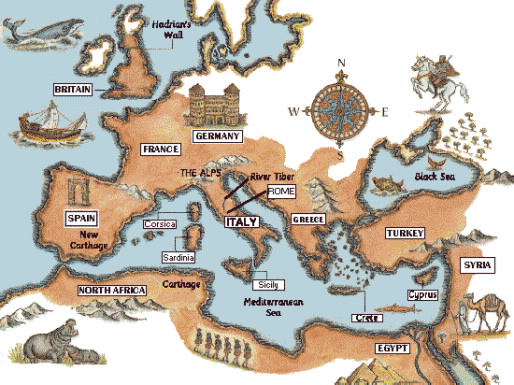
Latin was at first the language
of Latium, the ancient name of the area around the mouth of the River
Tiber on the western coast of Italy. Between the 4th
and the 1st. centuries before the birth of Christ the people
of Rome conquered Latium, then all Italy and finally of much of Europe,
North Africa and the Middle East. Roman soldiers, traders and settlers
spread Latin throughout their empire.
Fig.1: The
Roman Empire in the Second Century A.D,
The Roman Empire collapsed
in the 5th century after Christ but Latin continued to be spoken in
many parts of southern Europe. There were already differences in the
way the language was spoken in different areas and these different dialects
(方言)
gradually changed into Spanish, Portuguese, French and Italian. Because
they developed from Latin spoken by the Romans, these modern languages
are known as `Romance languages’ and we also sometimes use the word
`Latin’ as an adjective for the peoples and cultures associated with
them. Thus Central and South America, where Spanish or Portuguese are
spoken, are known as `Latin America.’
The similarities between Latin
and the modern Romance languages can easily be seen by comparing the
present tense of the verb `love’ in each of them (see Table 1, pg.2).
Written French has changed more than written Spanish, Portuguese or
Italian and spoken French (shown in phonetic symbols) has changed
even more. A Spaniard can understand most simple sentences in Italian
(and vice versa) but, unless they have studied French, neither of them
will understand a French person speaking. However, all Romance languages
are still so close to the original Latin and to each other that learning
a little of any one of them makes it easier when you start learning
another.
English is not a Romance language
but it has borrowed many words directly from Latin (e.g. velocity (<
velocitas), altitude (<altitudo)) and others indirectly
though French (e.g. measure (<Old Fr. mesure
< Lat. mensura), beef (< Fr. boeuf
< Lat. bovem, cow)). This means that if you know the background
to a Latin passage you may be able to guess what it is about even before
you have started Latin lessons.
Table 1:
The Verb `love’ in the Romance Languages
LATIN SPANISH PORTUGUESE
ITALIAN FRENCH ENGLISH
AMOAMO AMO AMO AIME /eim/ (I) love
AMAS AMAS AMAS AMI AIMES
/eim/ (You) love (s.)#
AMATAMA AMA AMA AIME
/eim/ (He/she) loves
AMAMUS AMAMOS AMAMOS AMIAMO AIMONS
/eimõ/* (We) love
AMATIS AMÁIS AMAIS AMATE AIMEZ
/eimei/ (You) love (pl.)
AMANT AMAN AMAM AMANO AIMENT /eim/ (They) love
NOTES:
# There is a special form for
the singular in Old English - `(thou) lovest’
* The sign ~ over a vowel means
that it is pronounced nasally, with air escaping through the nose as
well as through the mouth.
_____________________
Although Latin was no longer
spoken as a mother tongue after about 600 A.D., for many centuries it
remained the official language of the Christian church in Europe. After
the Reformation (宗教改革), the Protestant churches began to
use local, spoken languages but the Catholic Church (天主教教會) used Latin for its most important
ceremony, the Mass, until the 1960s and even today the Pope’s most
important statements are still translated into it. During the
Middle Ages (中世紀), government records were kept in
Latin and scholars and political leaders used it as an international
language, in the same way that French was used from the 18th
to the early 20th century and that English is used now.
Until the 17th century,
scientists usually published their results in Latin. They then switched
to using the language of their own country, and Isaac Newton’s
Principia Mathematica (1687), which explained his theory of gravitation,
was one of the last important scientific books to be written in the
old language. However, Latin is still used today by biologists for giving
scientific names to different species (e.g. Musca domestica =
the house fly) and descriptions of new plant species are also still
published in Latin.
_____________________
Figure 2:
Newton’s Laws of Motion from Principia Mathematica1
Lex I
Corpus omne
perseverare in statu suo quiescendi vel movendi uniformiter in directum,
nisi quatenus illud a viribus impressis cogitur statum suum mutare.
[That every
object remains in its state of rest or of movement at a constant speed
in a straight line except in so far as
it is made to change its state by forces applied to it]
Lex II
Mutationem motus
proportionalem esse vi motrici impressæ, & fieri secundum lineam
rectam qua vis illa imprimitur.
[That acceleration
is proportional to the applied motive
force and takes place in a straight line in the same direction as the
application of that force]
Lex III
Actioni contrariam
semper & æqualem esse reactionem: sive corporum duorum actiones
in se mutuo semper esse æquales & in partes contrarias dirigi.
[That there
is always an opposite and equal reaction to every action: that is, the
actions of two objects upon one another are always equal and in opposite
directions]
________________________
Even after modern European
languages had taken over its old functions, Latin remained an important
part of the school syllabus in Europe until modern times. At the grammar
school where I was myself a student in the 1960s, most of us studied
Lain until F5 and a few people (including me) studied it also in F6
and 7 and at university. Latin is not now so widely taught in British
schools2 but it is still quite important in Italy and some
other European countries.
Those who still study Latin
normally learn it only as a written language and use it just to read
ancient Roman literature. However, nowadays some scholars use Latin
to send e-mails to each other and also even talk to each other in it.
Examples of Latin e-mails can be read on the website of Finnish radio,
which hosts a Latin Internet discussion group. The same site lets you
hear and read a Latin news bulletin every week ( http://www.yleradio1.fi/nuntii.). There are readings of passages
from ancient Latin and Greek literature at http://www.pyrrha.demon.co.uk/psound3.html. and videos of people speaking
Latin at the University of Kentucky at http://www.uky.edu/AS/Classics/videocasts/ Finally, the Romans in Mel Gibson’s
film, The Passion of the Christ,
all speak in Latin. The filmmakers tried to make this like the simpler
Latin we believe ordinary people spoke at this time. The written Latin
which was used by educated people and which we study today was rather
more complicated.
The structure of Latin
The main difference between
Latin and English is that Latin makes very many changes to the endings
of words to show their grammatical role within the sentence. English
sometimes does the same thing (e.g. he changes into him
when it is the object of a verb and do changes into did
when it becomes past tense). However, English (like Chinese) mainly
relies just on word order and on adding additional words.
As an example of the Latin
method, look at the following sentence:
Marce, Paulus militis
pecuniam Petro in templo dedit
Mark, Paul
soldier’s money to-Peter in temple gave
i.e Mark, Paul gave
the soldier’s money to Peter in the temple.
In the dictionary, the Latin
for the English words would be listed like this:
Mark – Marcus, soldier – miles Peter – Petrus give– do
Paul
– Paulus money – pecunia temple
– templum
,
In the sentence, only Paulus
(the subject of the sentence) keeps its dictionary form. The other words
change in different ways:
Marcus becomes
Marce, to show he is the person being talked to.
We have militis
instead of miles to show the soldier owns the money (English
adds `s in the same way – soldier’s)
An m
is added to pecunia as the word is the direct object of the verb.
The –o
ending for Petro marks the word as the indirect object of the
verb
The –o
of templo is needed as the word is used with the preposition
in to show where the action happened.
Finally, the verb
form dedit shows both the tense (past) and also that the subject
is one person or thing not taking part in the conversation. The
form do in our list actually means `I give’. Among many other
forms of the same verb are dedimus (`We gave’), datur
(`is given’) and dabimini
(`you (plural) will be given’).
This system seems very complicated
at first but you need only learn the different endings a few at a time
and it will become easier. Because the endings of words give so much
information, one word in Latin often does the job of two or more in
English. For example, Crucio
(one of the Unforgivable Curses in the Harry Potter books) means `I
torture!’ The Latin system also gives a speaker or writer freedom
to change the order of words to emphasise a particular part of the sentence
or to fit the rhythm of a poem. For example, although Latin normally
has the word order subject-object-verb (e.g. Marcus Petrum videt
– Mark sees Peter), we could also say Petrum Marcus videt if
we are especially interested in the fact that it was Peter, not somebody
else, that Mark saw. An example from poetry is the opening lines from
a famous poem by the Roman writer Horace. He is pretending to be speaking
to a former (real or imaginary) girl-friend.
Quis
multa gracilis te puer in
rosa
What many slender you youth amongrose
Perfusus
liquidis urget odoribus
Soaked
liquid courts perfumes-in
The endings of the words tell
us that puer is the subject of the sentence and goes together
with the adjectives quis and gracilis and the participle
perfusus. Similarly, we know that te is the object
of the verb and that multa descibes rosa. So the English
meaning is: `What slender youth, soaked in liquid perfumes, courts you
(向您求愛)
among many a rose.’
In the modern Romance languages,
the different endings on nouns have disappeared. However, especially
in Spanish and Italian, the verb endings have often been kept with only
small changes, as we saw for the present tense in Table 1.
Until recently, people learning
Latin were expected to concentrate first on quickly learning all the
many different endings which nouns, adjectives and verbs can have. However,
schools still teaching Latin nowadays concentrate first on reading and
building up vocabulary, and only introduce grammatical rules when they
are needed. The central part of the Cambridge Latin Course, which will
be used in Europe Club lessons, is a series of simple stories about
people living in ancient Rome. You can see the Cambridge material at http://www.cambridgescp.com/latin/clc/onlineA/clc_onlineA_b1.php
The pronunciation of Latin
We cannot be completely sure
how Latin originally sounded but we know roughly what it was like because
we have descriptions of Roman speech by ancient authors and we
can also compare how the sounds developed in the modern Romance languages.
Today scholars usually read (or speak) Latin using what we think were
the original sounds. However, the Catholic Church (天主教教會) still uses a pronunciation based
on that of modern Italian and you will often hear this in recordings
of church music or of medieval Latin. In the table below, the church
pronunciation has been given in square brackets after the original sound.
VOWELS
The main vowels each had a
short and a long sound. In Latin as the Romans wrote it, and as it is
usually printed today, the vowel is written the same way whether it
is pronounced short or long. However, in texts written for beginners
long vowels are often marked by a straight line over the top.
Ā
(long) like /A:/ in father A (short) roughly like /Q/ in
hat
Ē (long) roughly
like /eI/
in dayE (short) like /e/ in bed
Ī
(long) like /i:/ in see I
(short) like /i/ in sit
(when followed by another consonant,
I normally had the sound /j/ as in yard. In medieval (中世紀的)documents
this sound is often written as J, but there was no J in
the original Latin alphabet))
Ō
(long) like /«U/ in go O
(short) like // in got
Ū
(long) like /u:/ in fool U
(short) like /U/ in full
DIPHTHONGS
AE like /aI/
in die [Church pronunciation is. like /eI/ in day or /e/ in bed.
This pronunciation is also used by the readers of Latin news on
Finnish Radio (http://www.yleradio1.fi/nuntii. ), even though they follow
the original pronunciation for most other Latin sounds)
OE like /I/
in oil
AU like /aU/
in out
EI like /eI/
in day (but often these two letters were pronounced as separate vowels
- /e-i:/ )
CONSONANTS
These were always pronounced
as written, so a double consonant was pronounced as two separate sounds
or as a longer sound than that represented by a single consonant. So
ille (that) was pronounced il-le
C always like /k/ in
cake or king [in church pronunciation, C has the
sound /tS/ (as in church) when
it comes before I or E]
G always like /g/ in
good or girl [in church pronunciation G has
the sound /dZ/ (as in gentle) when
it comes before I
or E]
M when reading Latin
today, we nearly always pronounce this like English /m/. However, the
Romans
themselves,
at least in poetry, often did not pronounce a final M fully.
Instead the vowel before it
was
nasalised, that is, air passed out through the speaker’s nose as well
as his month. There are
many
vowels of this kind in modern French.
T always like /t/ in
tin [in church pronunciation, T has the sound /ts/ (as in
hats) when it is followed
by I or E]
V like /w/ in we
[in church pronunciation, V has the sound /v/ as in very]
(in the Romans’ own alphabet
V was just another shape for U and both letters could represent
either the vowel sound /v/ or the consonant /w/. However, when Latin
is printed today, only U is normally used for the vowel sound
and only V for the consonant. An exception is in the letter combination
QU, where we write U but use the pronunciation /kw/ - this,
of course, is normally the way QU is pronounced in English –
e.g. queen, question etc.).
STRESS:
Latin words were never stressed
on their final syllable, so in a word of two syllables the stress was
always on the first (this is what usually – but not always- happens
with English two-syllable words).
When a word had three or more
syllables, the stress was either on the second-to-last or on the third
syllable from the end:
If the vowel in the second-to-last
syllable was long OR if it was followed by two or
more consonants, the second-last-syllable was stressed.
If the vowel in the second-last syllable
was short and was not followed by two
consonants,
the stress was placed on the third
syllable from the end.
In using these rules, you need
to remember that:
An l or r
following another consonant was regarded as combining with that consonant
to form a single sound. Thus combinations like dr, cl
etc.did NOT make a short vowel in front able to take the stress.
The consonant x
was really two sounds /ks/, so a short vowel in front COULD take the
stress
The letter h
was ignored in counting the number of consonants
Some examples of how this system
works are given below. The stressed vowel is shown italicised and
in red:
āmō
(I love) Two-syllable word, stress on first syllable
āmās
(You (sing.) love) Two-syllable word, stress on first syllable
āmāmus
(We love) Three-syllable word, stress on second syllable from
the end as it has
a
long vowel
contendunt
(They struggle) Three-syllable word, stress on second syllable
from the end as the
vowel,
although short, is followed by two consonants
extraxi
(I dragged out) Three-syllable word, stress on second syllable
from the end as the
short vowel is followed by x, which counts as two consonants
corrigunt
(They correct) Three syllable word, stress on third syllable from
the end as the
second vowel
from the end is short and there is only one consonant after it.
exedra Three syllable word, stress
on third syllable from the end as the
second vowel from the end is short
and is followed by dr, which
counts
as only one consonant
dominus
(lord) Three syllable word, stress on third syllable from the
end as the
second vowel
from the end is short and there is only one consonant after it.
PRONUNCIATION OF POETRY
Before the medieval period
(中世紀),
Latin poetry did not depend on stress patterns (as English poetry does)
but on the arrangement of long and short syllables. A syllable was regarded
as long if it was one which could take the stress in the second position
from the end, i.e. if it contained:
EITHER a long vowel
OR a short vowel followed by x
OR a short vowel followed by two consonants
(if h was not one of the consonants and
if the second one was not l
or r)
In the last-but-one syllable
of words with more than two syllables, a long syllable was thus also
a stressed one, but in other positions short syllables could be stressed.
When a word ending with a vowel
(or with vowel- plus- m) came before a word beginning with a
vowel, the final vowel was normally not pronounced. Thus multum ille
et was pronounced mult’ ill’ et
. The reason for treating vowel-plus- m in the same way as a
simple vowel was probably that the m in such a position did not
have a separate sound of its own unless it was followed by another consonant
(see the CONSONANTS section above).
Now listen to a recording of
lines by the Roman poet Virgil (W:\Subjects\English\Europe Club\Aeneid
Reading on the school intranet, or at http://www.rhapsodes.fll.vt.edu/aeneid1.htm - Real Player is needed). This is
the start of the Aeneid, the story of Aeneas, who was believed to have
been the ancestor of the first kings of Rome and also of the Roman Emperor
Augustus, for whom Virgil wrote. According to the story, Aeneas
fled from Troy when it was captured by the Greeks and reached Italy,
despite attempts by Juno, the queen of the gods, to stop him. The recording
includes 49 lines and these can all be read in the file Aeneid Extract
in the Europe Club directory or on the website. In the seven lines
given here, the gaps in the Latin are for the translation to be shown
for each separate word. After listening once or twice you can try using
the pause button to repeat the lines after the speaker.
much also
and in-war suffered until found-could-he city
īnferretque
deōs Latiō, genus unde
Latīnum,
carrycould-he-also
gods to-Latium race from-whom Latin
Albānīque patrēs, atque
altae moenia Rōmae.
Alban-also fathers
and high walls
Rome’s
(In more idiomatic English:
I sing of war and of the man who, exiled by fate, first came from Troy’s
shores to Italy and the Lavinian coasts. He was troubled much on land
and at sea through the violence of the gods because of the memorable
anger of cruel Juno. He also suffered much in war until he could found
a city and bring his own gods into Latium. From him came the Latin race,
the Alban fathers and the walls of towering Rome.)
In the medieval period (中世紀),
most Latin poetry did not follow this system but instead used a pattern
of stressed and unstressed syllables to give the rhythm, just as in
modern English poetry. Medieval Latin poems also often had rhyming
words at the end of the lines. Here is the first verse of `Gaudeamus
Igitur’, a famous student song, which was probably written after the
end of the Middle Ages but which follows the medieval system. It is
normally sung to a tune written down in 1781 and later included by Brahms
in his `Academic Festival Overture’.