多蘿西·戴 Dorothy Day(1897 – 1980)
美國天主教工人運動的創建者
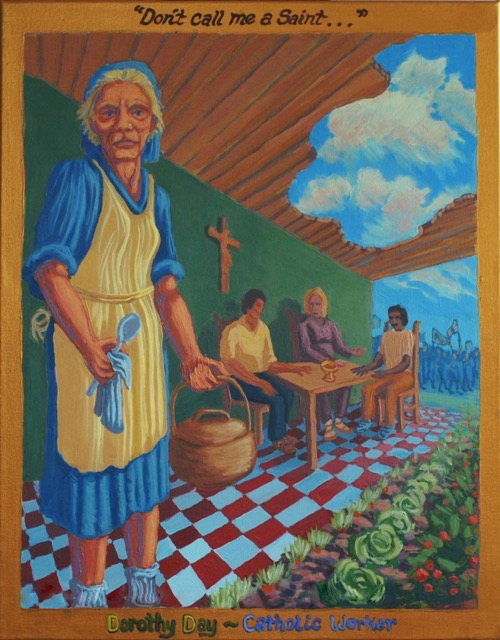
在這張圖片中,多蘿西在天主教工人運動之家為「三位」無家可歸者服務,而就在門外,一場抗議遊行正在街道上進行。
我們渴望為自己和他人伸張正義,但這往往會使問題複雜化,滋長派系和爭吵。世俗的正義與超自然的正義截然不同。超自然的途徑,若能理解,便是以德報怨,甘願捨棄所有,毫無殉道之心,以卑微、默默無聞、被輕視為榮。那時我並未自詡為基督徒,卻自詡為激進份子。然而,我並非一個合格的激進份子。我隨心所欲,任由「自己內心的念頭和慾望驅使」。有時,這或許正是波特萊爾所說的「選擇通往救贖的下坡路」。
p.58
Our desire for justice for ourselves and for others often complicates the issue, builds up factions and quarrels. Worldly justice and unworldly justice are quite different things. The supernatural approach when understood is to turn the other cheek, to give up what one has, willingly, gladly, with no spirit of martyrdom, to rejoice in being the least, to be unrecognized, the slighted. I was making no pretensions to being a Christian at the time, but I was professing to be a radical. But I was not a good one. I was following the "devices and desires of my own heart." Sometimes it was perhaps the Baudelairian idea of "choosing the downward path that leads to salvation."
p144
Not long afterward a priest wanted me to write a story of my conversion, telling how the social teaching of the Church had led me to embrace Catholicism. But I knew nothing of the social teaching of the Church at that time. I had never heard of the encyclicals. I felt that the Church was the Church of the poor, that St. Patrick's had been built from the pennies of servant girls, that it cared for the emigrant, it established hospitals, orphanages, day nurseries, houses of the Good Shepherd, homes for the aged, but at the same time, I felt that it did not set its face against a social order which made so much charity in the present sense of the word necessary. I felt that charity was a word to choke over. Who wanted charity? And it was not just human pride but a strong sense of man's dignity and worth, and what was due to him in justice, that made me resent, rather than feel proud of so mighty a sum total of Catholic institutions. Besides, more and more they were taking help from the state, and in taking from the state, they had to render to the state. They came under the head of Community Chest and discriminatory charity, centralizing and departmentalizing, involving themselves with bureaus, building, red tape, legislation, at the expense of human values. By "they," I suppose one always means the bishops, but as Harry Bridges once pointed out to me, "they" also are victims of the system.